Over the past year, we've seen predictions about AI's impact on everything: work, jobs, buying, even thinking. Some use it to scare people just to sell their AI-'solutions'; others to justify short-term cuts and boost operational margins.
But here's the truth: most of these predictions are built on self-serving assumptions, not evidence.
We're now entering the dip after the hype — what Gartner calls the "Trough of Disillusionment." Early signs are already visible. AI's impact on productivity is mixed: research from CSIRO and MIT Sloan shows gains for less experienced workers, but slowdowns for experts who spend more time correcting AI output.
Many projects fail to deliver value. Both The Guardian and Harvard Business Review note that AI-generated content often adds workload rather than reducing it. The "productivity paradox" is real — long-term gains may come, but short-term friction dominates.
Take Microsoft, for example: they rolled out (or is it forced) hundreds of thousands of Copilot licenses assuming productivity would follow. It didn't.
And knowing that many AI solution providers also laid off teams preemptively, one could say it borders on hypocrisy. They are not doing anyone a favor to say the least.
GTM
Yes, AI is most likely transforming the way we go — or will go — to market. But why is the narrative so often that it will redefine the fundamentals? Do we even know that to be true? Why couldn't AI instead be the force that reveals existing flaws rather than redefines everything?
In sales and marketing, AI isn't rewriting the playbook; it's probably right now more exposing where the old one was broken. Misaligned processes, disconnected data, and poor handoffs between teams have long slowed organizations down. AI simply makes those inefficiencies more visible — and, for those willing to adapt, easier to fix.
Zooming in on day to day Buying and Selling
So what about productivity gains or losses in B2B buying and selling? What's really changed? We're seeing the same pattern. So-called thought leaders keep publishing "new buyer journey" — or, god forbid, "funnel" graphics — where every stage is suddenly replaced by AI.
The claim being made is that most — if not everything — is now affected by AI. That statement, of course, has some validity. But alongside that rather obvious observation, we also see many unproven consequences being presented with the same level of confidence.
For example, the general tone suggests that the major outcome is an even greater shift in decision-making during buying and selling — moving from human-sourced information to machines.
Well, is that really the case?
I've even seen some more questionable claims lately:
- Assertions that search engine usage will be replaced by GPT-powered search — while assuming people's search behavior and expectations will somehow remain the same.
- Even bolder predictions suggesting that buyers will rely (blindly) more on GPTs than they ever did on search engines.
- And then there's the idea that AI is disrupting the "linear funnel" — as if that model hadn't already been debunked years before GenAI even saw daylight.
The hype is loud. The facts, less so.
It seems few of these guru's have tested if that is actually true, i.e. HOW AI actually changes the way B2B decisions are made should not be part of predictions. Instead shouldn't we just measure it?
Facts matter
Together with 6sense, we decided to test it — for real. Several thousands of enterprise buyers and companies got interviewed about how they currently go about procuring solutions to their business challenges
Two years after the original study that redefined how we understand B2B buying, we went back to the data to see what AI has actually changed. And you'll be surprised. There is a lot of change but perhaps not the change you were expecting.
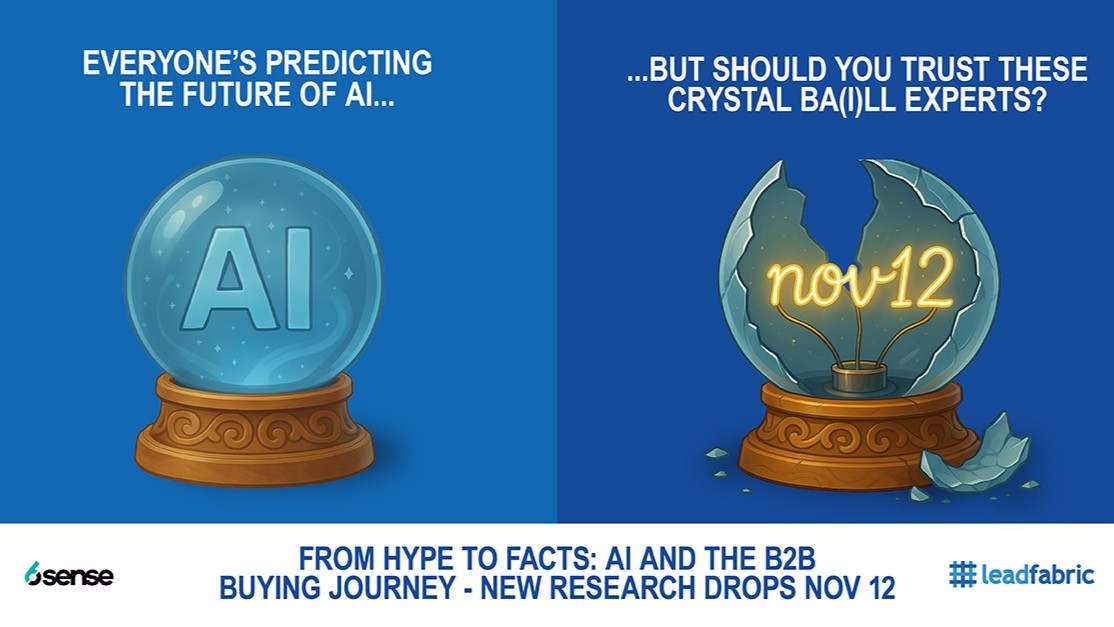
Results drop Nov 12 at 6sense's annual conference — including a European Focus report we co-authored with the leader in Revenue Marketing Platforms.
So… who do you trust to shape your next move? Those selling predictions — or those testing them to craft solutions you need and that actually work?
Stay tuned and follow our channel to receive the report as soon as it is released. Ungated. Promised!
Contributors
-

Koen De Witte
LinkedIn