

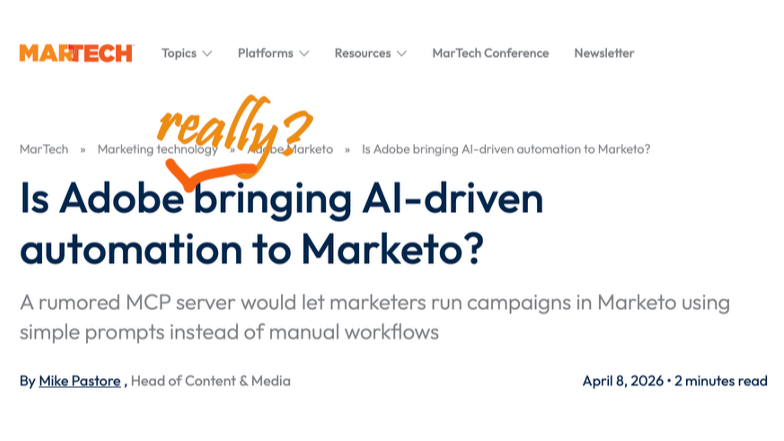
Ahead of their annual conference in Las Vegas, it seems Adobe let news slip to their fan base — people working at smaller European partners — and the LinkedIn posts are now doing the amplification work. The concrete news: a Marketo MCP server. And the reaction suggests people believe this changes everything. I'd encourage a bit more critical thinking before drawing that conclusion.
What makes it more telling is how some of these champions are explaining the value. One described the main breakthrough as being able to "connect Claude." That's the depth of analysis we're working with here.
What's being described, as far as I can tell, boils down to two things: the ability to export context out of Marketo, to augment it and eventually do some UI automation. By adding an MCP layer, they've enabled LLMS to listen and agents to talk to Marketo — and the flagship use case that has surfaced is being able to prompt it to build a smart campaign instead of clicking through the interface manually. That's friction reduction. Not architectural transformation.
Some of the drawings I noticed kept referring to Marketo as the core segmentation engine.
And here's where buyers should pay close attention before getting swept up in the momentum: if agents are autonomously generating smart campaigns, trigger logic, and programme structures inside Marketo's existing architecture — you're wrapping a rules-based, lead-centric system with an agentic layer that doesn't touch the (limited) underlying data model. It just automates the manual steps within it, orchestrating individual conversations without using the context on how these contacts are related to their buying group.
There's also a governance problem nobody is talking about. Marketo configurations are already notoriously hard to audit when humans build them — naming conventions, exclusion logic, trigger protocols. Add AI-generated logic on top of that, without a clear framework for how the agent follows your standards, and that complexity doesn't simplify. It compounds.
The harder question that isn't being answered: how does the MCP server and its agents ensure they build things the right way — your way?
This isn't fixing much IMO. It's extending the lifecycle of a product with a fundamental architectural constraint. Marketo was built around the lead as the atomic unit of marketing. An MCP server and an agentic wrapper don't give customers what they actually need — a buying group-centric orchestrator with AI embedded at the core decisioning layer. One that can process account-level signals, engage entire buying committees, and actually unlock what generative AI makes possible in B2B go-to-market.
Adobe is making the old thing easier to operate. So is Salesforce with Agentforce on top of a lead centric CRM. Both are valid incremental improvements. But to me the market needs a new thing — AI-native, with a data model built around how B2B buying actually works.
For teams currently on Marketo, the answer isn't the same for everyone.
Many large enterprises with deeply integrated MAPs and lead-centric demand gen programmes already know that their internal IT processes won't allow a enterprise wide rip-and-replace to be the first move. The more urgent transition is shifting to buying group activation. Vendors like Clay moving upstream into enterprise can act as add-ons to patch some of the missing functionality — and that will unlock interesting possibilities — but it will require significant custom builds, and over time that introduces its own governance challenges.
In that context, the existing MAP can remain in place, but scoped down to what it actually does well: personalisation of individual communications. That's it. A second-generation MAP or even some of the upgraded ones like Salesforce Marketing Cloud next don't understand buying groups. It doesn't know how to use the context of other contacts associated to the same account to enrich its decisioning. That orchestration needs to happen outside the MAP — and for early stage opportunities revenue platforms like 6sense this makes... sense. But let's be honest: that architecture still gets complex quickly, especially for highly engaged opportunities and that complexity has a cost.
For more agile enterprises, or their departments as well as mid-sized companies with more room to move, I'd keep a close eye on what's coming. Next-generation MAPs being built from the ground up — with AI at the core and buying groups as the centre piece of the data model — are starting to emerge. Nothing has hit the market yet as a general-purpose B2B platform for the complex sale, but it doesn't feel far off.
And if you're currently in a SaaS renewal conversation with a second-generation, lead-centric MAP vendor: be prudent. Don't get lured into a multi-year contract that is essentially funding the extended lifecycle of something that is end-of-life at its core. The dynamic I worry about most is that the brand equity of players like Adobe and Salesforce is giving IT and procurement teams false confidence — while the marketing and rev ops people in the room often know better, but don't always win that argument.
Contributors
-

Koen De Witte
LinkedIn